Open Tech Today - Top Stories

Tuesday, March 27, 2007

One Laptop per Millionaire


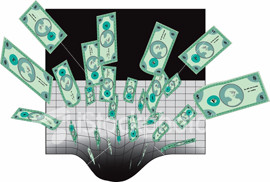
The difference between this



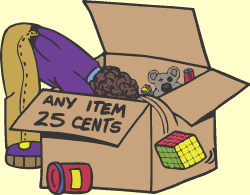
... and this ...


... is more than a few zeros.

Forget the $100 laptop per child.

A UK-based company Luvaglio is offering the world's first $1 million laptop. No, that is not a typo. And the company is being very secretive about it. Entering their website is by appointment only.

What does $1 million buy in a laptop? A 17-inch, special anti-glare, self-cleaning screen, 128GB hard drive, and ... wait for it ... a removable diamond power button that also serves as security identification.

One laptop per millionaire. As the Luvaglio website says, "We're not interested in 'mass production' or designing entry-level products ... or children." (OK, I added that last part)

Conspicuous consumption trumps social entrepreneurship? Maybe not.

Luvaglio is obviously targeting the other end of the Digital Divide -- the ultra rich who have been unable to join the Age of Computers.


Categories: OLPC, digitaldivide

Monday, March 26, 2007

Democracy Meets Open Standards in Texas

Tomorrow, an unusual thing will happen. Open standards -- for most a very technical and opaque matter -- will be the subject of a political hearing in Texas. State lawmakers will debate adoption of a technology policy for Texas in which open standards will have a central role.

Public comments (by Texas residents or anyone else, non-residents, even non-Americans) may be sent online here.

It will be a chance for lawmakers to hear about the value and importance of open standards -- to drive innovation, to ensure future access to public records, for cost savings and public control over vital IT infrastructure.

The hearings will be publicly webcast live.

Here is the link for the House hearing at 10:30AM.

And here for the Senate hearing at 1:30PM.


Categories: OpenStandards, Texas

Friday, March 23, 2007

China: Spam Champion


Wonder where most of your spam is coming from? Asia. According to Semantec, a well-known anti-virus company, 69% of all emails originating from Asia are spam. And China leads the way, generating the most spam in the world by volume.


I don't know if this is accurate, but I do know that almost all of the spam "comments" received on this blog are from IP addresses in China. It seems China is emitting spam at a rate that rivals its CO2 emissions.

Categories: China, spam

Wednesday, March 21, 2007

Problems? Blame the Blogs

That is what the Malaysian government is doing apparently. Malaysia's Information Minister has warned newspapers (and by extension citizens) against using blogs as sources of information. According to the Star newspaper, Minister Zainuddin Maidin described blogs as "anarchist websites" and said most websites are run by frustrated journalists and political pundits.

Governments, companies and politicians worldwide are having difficulty adjusting to our wired world. The Internet disintermediates government and others who have traditionally filtered or rationed information. News oligopolies have ended.

Today, individuals can easily and instantaneously project their ideas, opinions and reporting out to the world. It can be a painful experience, as the Malaysian government discovered when allegations of corruption appeared in blogs and were later picked up by mainstream media.

Instant, unfiltered access to information is good. Yet, people still have a responsibility to assess (and question) the credibility of sources -- whether they are blogs or government-controlled media.

It's hard to lose control, and easy to scapegoat bloggers, as I noted here in connection with a company targeting a widely read blog.

As with most things, however, the fault lies not in our blogs but in ourselves.


Categories: Malaysia, blogging

Tuesday, March 20, 2007

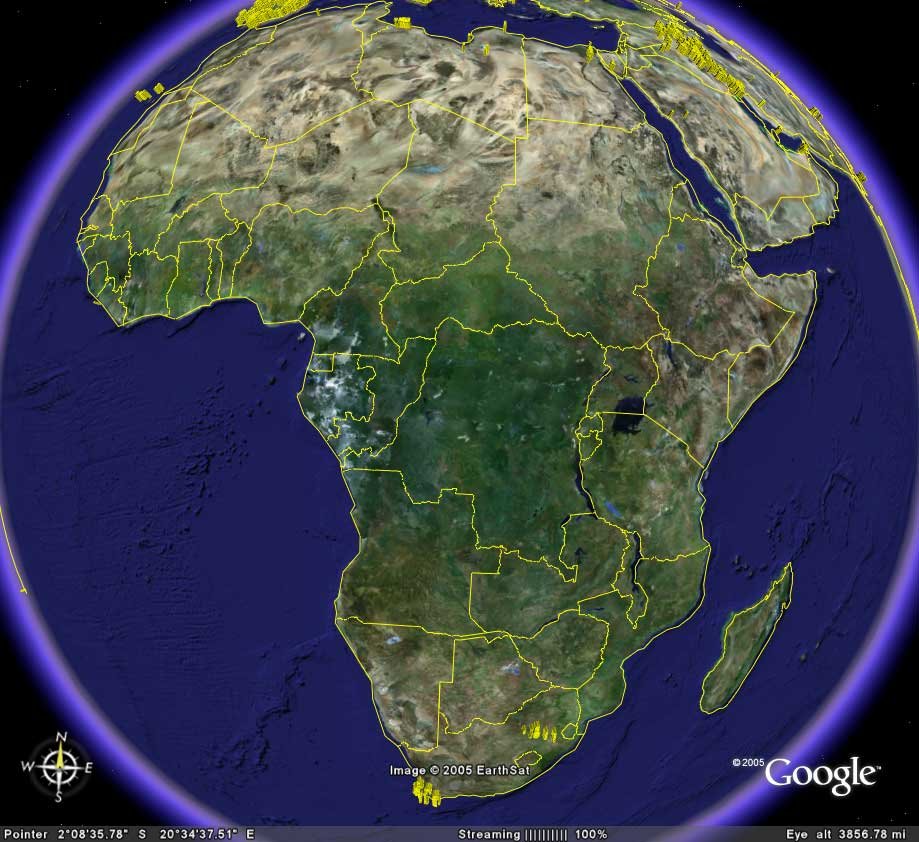
Google Lands in Africa

By now, many of you have seen the news about Google's partnerships in Africa with the Rwandan Ministry of Infrastructure and the Kenya Education Network (KENET). Google will supply Google Apps software to thousands of students in both countries as well as government officials in Rwanda.

Three important things are happening here.

First, more and more core business services are becoming Web-based and Web-accessed.

Second, Google sees that partnerships in emerging markets (with governments and educational institutions) is the way to win early mindshare and market share, not to mention goodwill from local communities.

Third, in many countries the public sector is the key catalyst and lead adopter for application of new technologies (unlike in the US).

In many of these markets, users will jump right to communication, business and data management tools delivered over the Internet -- avoiding the pain and expense of installing (and maintaining) business software on their individual computers.

No licensing, no lock-in.

To put it in Monopoly terms, "Go to the Web, go directly to the Web; pass licensing, do not pay $200.”


Categories: google, Africa

Friday, March 16, 2007

The (Small) Business Case for Open Source


If the code for open source can be shared, why not the business cases for it? No reason at all, says one UK company that will blog its experiences migrating an entire small business IT infrastructure to open source.

Mercian Labels, a 20-person maker of custom printed self-adhesive labels (and who doesn't love them?), posted a press release on its corporate blog announcing the start of its open source migration and its case study. As the migration proceeds, the company will blog about its strategic decisions, cost benefit analysis, technical options and problems faced during its open source journey.

To grow the open source user base, sharing best practices, case studies and business cases is just as important as sharing code -- especially for resource-challenged small and medium-sized enterprises (SMEs). And as Mercian found, SMEs may be positioned to realize returns on their open source investments faster than larger companies.

For Mercian, the switch to open source was an easy decision. Its business case balanced new costs of training, internal development and support against its existing costs from viral damage to mission critical servers, uncontrollable system changes, security threats and expensive upgrade paths.

Mercian decided to take control of its own IT destiny. Control, cost and future flexibility make open source an unbeatable component of its small business success. And even accounting for new costs, the company projects a positive (dollar) return on its investment in 1 year.


Categories: opensource, businesscase, SME

Tuesday, March 13, 2007

Why IT Projects Fail?

Your technology project has failed. Most likely it was not the technology that failed to deliver; it was you paying too little attention on your people, schedules and budgets. According to a recent company survey, the top 3 reasons for the failure of tech projects are: poor communications, unrealistic schedules and insufficient resource planning.

While most managers focus on the high-priced hardware, the complex architecture and technical issues, it is the "soft" issues that end up hurting a project the most -- people who do not communicate well, inattention to how long tasks take to complete, and not enough money and people to do the job well and on time.

Planning for project success means planning to communicate up, down and across the org chart. Communication is not an ad hoc activity; processes need to be defined so people know when and what they are expected to communicate.

People, schedules and budgets are the 3 pillars of successful IT projects.

Categories: ITprojects, communications

Sunday, March 11, 2007

Open Source Politics in the UK

Open source was thrust into the rough-and-tumble of British politics this week when the Tory Party's shadow chancellor criticized Tony Blair's Labor Party for its failure to expand use of open source software in government.

George Osborne seems to get it, and he spoke with clarity and passion. In his remarks (full speech is here), he complained of the uneven playing field for open source in government procurement.

But his challenge went beyond procurement rules. Osbourne called for a change in the culture of government in the digital age, and presented a technology strategy for the Conservative Party based upon three pillars: equality of information, social networking and open source. And not just open source as software but open source as a powerful model for mass collaboration.

Open source politics does not mean open source dictatorship. A Conservative Party spokesperson underscored this after the speech:
"Procurement should be based on what best meets their needs. Functionality, performance, security, value and the cost of ownership of software should be the priority, not categorical preferences for open source software, commercial software, free software or any other software development model."
If only more politicians spoke like this.

Categories: opensource, UK, government

Tuesday, March 06, 2007

Next Victim of Global Warming: Japan


What is cold, white, flaky and missing in Japan this winter?


Snow.

According to Japan's Meteorological Agency, for the first time since records began in 1867, downtown Tokyo has had a winter with no snow. In fact, this is Japan's warmest winter ever.

And it is not only Tokyo that is suffering. Winter festivals across Japan have been canceled due to insufficient snow.

And a few time zones to the west, the UK has experienced its warmest year-long period ever, from March 2006 to February 2007. That is since 1659, when temperature records began being officially collected in England.

But I'm sure it has nothing to do with the global warming myth.

Categories: GlobalWarming, Japan, UK

Saturday, March 03, 2007

Enemies of Innovation

Empires are often built upon scarcity and control of distribution. Things like digital rights management (DRM) and proprietary ownership of standards are tools for protecting business empires. However, scarcity is the enemy of innovation. And the Internet is turning fortresses into sand castles.

The ultimate problem faced by companies fighting to maintain a death grip on their content (whether it's music, software code or news) is that the artificial scarcity of their content is disappearing. So are their distribution monopolies.

You do not need to watch CNN to see one of their news stories. You can find it online, and not only on the CNN website. It is likely posted on hundreds of blogs and other websites. It can be emailed to you, downloaded using BitTorrent, podcast or viewed on YouTube. The economics and business models of content are changing.

These new dynamics are explained with wonderful clarity by TechDirt in a series of articles about the economics of scarcity.

YouTube, open source, blogs, BitTorrent, Skype, Craig's List. They are all exploding old business models based on artificial scarcity, and shifting the competitive landscape for what value means in a wired world (and marketplace).

But this is not the end of the world. Scarcity is the enemy of innovation. Today, content scarcity is disappearing, but that only means that innovation can accelerate.

Categories: innovation, economics, DRM

Tuesday, February 27, 2007

ODF Isn't Just California Dreamin'

It looks like the OpenDocument Format (ODF) is coming to California. A State Assemblyman from San Francisco has tabled a bill that would require all state agencies to create, exchange and preserve public documents using open, XML-based file formats beginning January 1, 2008.


The bill is designed to make sure that open is as open does. It requires open file formats to be:

* interoperable among multiple platforms
* implemented by multiple vendors
* fully published and royalty free
* controlled by an open industry organization

From Massachusetts to Minnesota to California. It looks like ODF is making its own cross-country migration. Go West, young format!

Categories: ODF, standards, California

Monday, February 26, 2007

An Inconvenient Oscar

Last night a spotlight shined on the cause of global warming and Al Gore's interrupted political career when his PowerPoint-turned-film, An Inconvenient Truth, won the Academy Award for
best documentary.

Forget 2000. The Supreme Court can't strip him of the Oscar. And Al Gore's post-Washington career has been impressive. Professor, investment adviser, environmental advocate and Nobel Peace Prize nominee. Even more impressive, Gore has been right about the most important issues of the day -- the power of the Internet, Iraq and global warming.

As the Vice President noted, the fight against global warming only depends on the will to act, a renewable resource. So, is Al Gore's political career another renewable resource?


Categories: GlobalWarming, AlGore

Thursday, February 22, 2007

South Africa Recommits to Open Source

Today the South African Cabinet issued a new policy for technology in government, deepening its commitment to open source and open standards.

In its statement, the Cabinet said: "All new software developed for or by the government will be based on open standards, and government will itself migrate current software to FOSS."

Smartly, the South African government avoided setting any timetables or quotas. Instead, it focused on the benefits that open technologies afford the government and the country: lowering costs (for agencies, schools, communities and homes), enhancing IT skills and streamlining local software development.

It will also establish a project management office dedicated to implementing its new policy and expanding adoption of open source across government.

The government-wide move on open ICT follows quickly on the heels of a a decision by the Council for Scientific and Industrial Research to adopt the open document format (ODF) as its default document format.


Categories: OpenSource, SouthAfrica, government

Tuesday, February 20, 2007

Google, Microsoft and Disruptive Business Models

Microsoft CEO Steve Ballmer admits that he's worried -- less about competitors and more about being blindsided by a new business model. He should be worried about the combination -- an innovative, resource-rich competitor building a new, disruptive business model (and the infrastructure to deliver it).

In a recent interview, Ballmer noted that Microsoft is playing catch up in search. That isn't news. Google has effectively won that battle. Ballmer also mentioned open source as a worrisome threat. That isn't news either, though it is not only the pricing pressure created by open source that should worry him. Open source has other powerful drivers behind its adoption globally.

However, Microsoft should be most worried about plans accidentally revealed during a Google presentation. Google is building the capacity for "infinite storage" -- meaning the ability to mirror someone's hard drive online and store all of their files, every e-mail, photo, mp3, web history, bookmark, and make them accessible on demand, anytime, anywhere, from any device.

Now that would be a disruptive business model.


Categories: Microsoft, Google, business

Monday, February 19, 2007

Are Newspapers Dying?

The Internet is killing newspapers. It is not a sudden demise, but more a death of a thousand cuts -- loss of readers (eyeballs, in online lexicon), classified ads and subscriptions. Is there any way for newspapers to compete against Craig's List and the headlines-on-homepage habits of consumers?

One newspaper publisher in Norway found an answer, and makes piles of money online. It did have the advantage of moving fast online in a small market, quickly becoming a big fish in a small pond. But it also did other things right -- including, most importantly, re-inventing its business model and hiring managers from outside the newspaper business. It built or bought links with other publications. It started giving content away for free and moved its classified ads online.

There are lessons here for other newspapers, other businesses and even governments in how to adjust to life (and business) in an online world ...

1. New leadership and management is often needed -- people not tied to the organization's old business models. The Consumer is king, not your old business model.

2. Recognize that you are selling services more than content.

3. Trust remains a key asset. Consumers prefer to source information and services from people (and brands) they trust. This is especially true online given the amount of garbage and scammers on the Internet.

4. Use trust to get online visitors coming to you directly, and not just through a search engine. Partnerships linking you with other visited sites can help get visitors through your front door, as opposed to the back door via a search engine.

5. Keep costs down. Providing services online can be very profitable, provided you take advantage of the cost savings that business online allows.


Categories: consumers, media, Internet

Friday, February 16, 2007

Global Warming's Next Victim: Peru

Global warming sure does produce pretty photos from distant places, pretty photos with ugly implications. The next page in the global warming scrapbook comes from Peru. While India is losing islands and Canada its ice shelfs, Peru is losing its glaciers.

A story from The Times (UK) reports the impending loss (that is, melting) of Quelccaya, the main glacier of the world’s largest tropical icecap, located in South America's Andies mountains. It is melting faster than scientists previously measured. Current prediction: Quelccaya will lose half its current mass by next year and disappear entirely by 2012, only 5 years from now.


Here is how the glacier's retreat has progressed in the past 25 years ...


But why worry about a pile of ice far off in the Andies Mountains?

Peru's glaciers feed the rivers that supply water to rural communities and cities where most of the population lives. Glaciers are vital for water supplies, essential for drinking, electricity and agriculture. No glaciers means less water, and less water means less food and more human hardship. It's a simple equation with devastating consequences.


Categories: GlobalWarming, Peru

Wednesday, February 14, 2007

Outing Groklaw & Open Source Bloggers

Anonymous blogging is becoming a risky proposition. And if you blog about legal issues related to open source, be prepared for real trouble. As part of its court case attacking Linux vendors and users, SCO has subpeonaed Groklaw blogger Pamela Jones, a frequent commentator on the SCO lawsuit. SCO intends to force Jones to sit for a deposition. Why? They claim Jones is somehow associated with IBM, or might even be one of its lawyers.

Even if true, what will SCO gain, other than the embarrassment of outing an online commentator or exposing how advocates use the Internet to project their views to the world? Groklaw posts about the SCO case are mainly commentary based upon court documents and filings. So SCO is basically harassing a blogger for her widely-read opinions (protected by the 1st Amendment of the US Constitution). Sounds like a cheap shot, and a move almost guaranteed to create a storm of bad press for SCO. And they would deserve it.

It is unclear what relevant evidence Jones (whoever she is) would have for the lawsuit and SCO. If she was a lawyer for IBM, any information beyond the blog posts would be protected by attorney-client privilege. If she is a paid mouthpiece for IBM or associated with it in some other way, nothing indicates that she has any information beyond what is publicly available in court documents. In the end, this looks like SCO attacking a person for her support for open source.

Allowing this subpeona of a blogger would set a dangerous precedent and send a chilling signal to anyone who posts online. Intimidation and reprisals should not be part of the blogging experience.


Categories: opensource, SCO, IBM, blogging

Tuesday, February 13, 2007

The Network Effect of Open Source

Open source is breaking out of software and starting to drive innovation in sectors beyond ICT. As pressures increase on companies (and labs and universities) to develop and discover faster, they are finding open source to be a model for networked collaboration and a catalyst for innovation.

The Human Genome Project is a famous example of open source collaboration in science. Now comes news that a giant drug company, Novartis, will build upon this open source approach for its diabetes research. Instead of hoarding its genetic data, Novartis is sharing it to create a library of diabetes data freely available online, expecting to both accelerate its own innovation and spur new partnerships.

Open source is making similar inroads in education, consumer products, even medical devices for amputees.

This connection between open source and innovation beyond software will be a focal point for the next phase of the Open ePolicy Group.

Categories: opensource, innovation, OeG

Wednesday, February 07, 2007

10 Things You Should Not Buy New


Interesting article on MSN Money by Liz Pulliam Weston listing 10 things you should generally never buy new (and it's more bad news for content creators) ...


1. Books
2. DVDs / CDs
3. Children's toys
4. Jewelry
5. Sports equipment
6. Timeshares (in real estate)
7. Cars
8. Software (and video games)
9. Office furniture
10. Hand Tools

Other things to add to the list ... clothes for kids under 2 years old? Skiis? Pets?

Anything you would add?

Monday, February 05, 2007

BBC Handcuffs Viewers to Microsoft

I love the BBC -- its news coverage, its TV shows, its website, its independence even in the face of pressure by its public paymasters. When it comes to technology, however, the BBC seems willing to trade that famous independence for a set of handcuffs.

Access to BBC on-demand TV services will be unavailable to consumers who do not have an up-to-date version of Microsoft Windows. It matters not what you think of Microsoft; forcing consumers to choose any single vendor, system or computer is unnecessary, wasteful and unfair.

Just ask the victims of Hurricane Katrina in 2005 who were unable to register online for disaster relief on the Federal Emergency Management Agency (FEMA) website. Online registration for disaster help required Internet Explorer initially.

The truth is: lock-in is a bad idea.

You can tell the BBC what you think about its plans on its website here.


Categories: consumers, lock-in, BBC, Microsoft