"IT should be apolitical."
So says Peter Quinn, CIO of the Commonwealth of Massachusetts.
In the midst of the furor over open document format, Quinn recently decried the politicization of IT policy, and its potential "chilling effect" on public officials.
Here is the U.S. we assume that ICT is not grist for the political mill. But that is not the case in many, or most, countries. In Europe, ICT policies are highly political, and explicitly so. Political parties take positions on ICT issues. In places like China and Brazil, the main drivers of open source are political considerations.
Is this a bad thing? Often not, especially when ICT policymaking is open for debate. Many technology decisions should be brought to public attention, and not the product of semi-private discussions with vendors.
It can be a painful process, as Peter Quinn can attest. But democracy and other collaborative endeavors are like that. Policymakers and the public should know the stakes involved. They are sometimes big, less about ICT and more about serious issues of public interest.
Saturday, December 17, 2005


Thursday, December 15, 2005
Document Formats - To the Winner Go the Spoils
Let the market decide. That is Microsoft's view on competing standards for document formats, as described in this recent MacWorld article.
That sounds fine . . . as long as people are clear that ODF and MS's "open" XML standard are not equivalents in terms of openness, control and genuine neutrality for platforms and 3rd party products.
As the Berkman Center's John Palfrey said, echoing some key points in the Open ePolicy Group's Roadmap for Open ICT Ecosystems, it's not about one company verses another. It's about access to the information you create today and tomorrow. It's about who should properly control public information.
A summary of John's remarks at yesterday's Open Forum on the Future of Electronic Data Formats for the Commonwealth at the Massachusetts State House is available at his blog.
So where is this competition going?
Will we see other governments take official positions on open document formats?
That sounds fine . . . as long as people are clear that ODF and MS's "open" XML standard are not equivalents in terms of openness, control and genuine neutrality for platforms and 3rd party products.
As the Berkman Center's John Palfrey said, echoing some key points in the Open ePolicy Group's Roadmap for Open ICT Ecosystems, it's not about one company verses another. It's about access to the information you create today and tomorrow. It's about who should properly control public information.
A summary of John's remarks at yesterday's Open Forum on the Future of Electronic Data Formats for the Commonwealth at the Massachusetts State House is available at his blog.
So where is this competition going?
Will we see other governments take official positions on open document formats?
Monday, December 12, 2005
Avoiding the ICT Stigma
A colleague, Jaap Bloem, shared an interesting perspective on the Roadmap Wiki on why governments and enterprises should consider openness:
It also reminds us that openness is not about the technology. Ultimately, introducing openness in ICT is about transforming companies, agencies, economies and people. It's about creating new avenues of innovation and collaboration. Those are the prizes that everyone's eyes should be on.
In part, Jaap's point is how to more effectively market openness to decision-makers, who often care little about technology. Maybe too much talk of ICT only makes it harder to get their attention.The Roadmap for Open ICT Ecosystems is a remarkably strong way of pleading the case for “digital openness”, thanks mainly to the compelling examples and to the Openness Maturity Model. However, it also is my strong feeling that we should push the notions “ICT” and “Ecosystems” a little more in the background; instead putting forward a more crisp, plain, understandable notion as a front-end.
My suggestion would be "Open [i]nvironments." This notion corresponds with the following equation:
Open [i]nvironments = Effective Information Environments =
[i]nfrastructures + [i]ndividuals + [i]ndustries.
It also reminds us that openness is not about the technology. Ultimately, introducing openness in ICT is about transforming companies, agencies, economies and people. It's about creating new avenues of innovation and collaboration. Those are the prizes that everyone's eyes should be on.
Wednesday, December 07, 2005
Open Document Formats
Just saw this article from today's (Dec. 7th) Bangkok Post
As it indicates, and as we highlighted in our Roadmap, the core issues regarding document formats are not technological. The issue is control, and what conditions should exist for access to public information.
Here's my prediction: Within 2 -3 years (or sooner) this whole debate about open document formats will be over. The case is clear and compelling. Open document formats assure future access to public information. As more governments and other customers demand control over their information --- and they will --- open document formats will be the accepted baseline for information formats, and every major vendor and application will support them.
What do you think?
As it indicates, and as we highlighted in our Roadmap, the core issues regarding document formats are not technological. The issue is control, and what conditions should exist for access to public information.
Here's my prediction: Within 2 -3 years (or sooner) this whole debate about open document formats will be over. The case is clear and compelling. Open document formats assure future access to public information. As more governments and other customers demand control over their information --- and they will --- open document formats will be the accepted baseline for information formats, and every major vendor and application will support them.
What do you think?
Monday, December 05, 2005
Maturity Models - Too Much of a Good Thing?
Maturity models are certainly proliferating. There are scores of them, evaluating everything from software to enterprise architecture. Many are freely available, some are proprietary. At least three exist for evaluating open source software.
When the Open ePolicy Group was developing the "Roadmap for Open ICT Ecosystems," there was considerable debate over whether we should offer a new maturity model. We saw a gap; we found no maturity model that gauged the openness of an entire ICT ecosystem. Maturity models, like people, tend to work in silos.
Not everyone in the Group, however, wanted to cast yet another maturity model out into the world. In the end, we decided to offer our Openness Maturity Model, not to guide any specific decision (e.g., choosing software) but rather to help policymakers and managers aggregate baseline data and chart a path toward more open ICT ecosystems.
Early feedback seems to validate our decision. People continue to say (most recently during my Roadmap presentation in Brazil last week) that the Openness Maturity Model is the single most useful thing in the Roadmap. People like tools, I guess. Though this one could still benefit from some more work under the hood, and it remains our hope that others will help develop it further using our wiki: http://wiki.openization.org
When the Open ePolicy Group was developing the "Roadmap for Open ICT Ecosystems," there was considerable debate over whether we should offer a new maturity model. We saw a gap; we found no maturity model that gauged the openness of an entire ICT ecosystem. Maturity models, like people, tend to work in silos.
Not everyone in the Group, however, wanted to cast yet another maturity model out into the world. In the end, we decided to offer our Openness Maturity Model, not to guide any specific decision (e.g., choosing software) but rather to help policymakers and managers aggregate baseline data and chart a path toward more open ICT ecosystems.
Early feedback seems to validate our decision. People continue to say (most recently during my Roadmap presentation in Brazil last week) that the Openness Maturity Model is the single most useful thing in the Roadmap. People like tools, I guess. Though this one could still benefit from some more work under the hood, and it remains our hope that others will help develop it further using our wiki: http://wiki.openization.org
Friday, December 02, 2005
Open ePolicy Group -- Phase 2
As my take-off to Amsterdam approaches, the issue of what Phase 2 of the OeG will look like is squarely on the table. Interest by companies and individuals is high--just this morning I had a call with Miko Matsumura, who chairs the OASIS committee on service-oriented architecture, to discuss the idea of a governance framework for service-oriented architectures. Both he and Patrick Gannon, OASIS' president, have genuine interest in the OeG's work and collaboration in a Phase 2.
Is a "roadmap" for SOA a big enough topic with high global demand to be the focus on the OeG for Phase 2? That's the question.
Other news: the Roadmap for Open ICT Ecosystems now has a wiki, here at:
http://wiki.openization.org
So now the whole world can join in the dialogue and help the Roadmap evolve.
The Roadmap also exists in portuguese and chinese (both available online). Spanish and thai versions are nearing completion.
With over 50,000 downloads from the Berkman Center's OeG website (See my Links), the word is definitely getting out.
Is a "roadmap" for SOA a big enough topic with high global demand to be the focus on the OeG for Phase 2? That's the question.
Other news: the Roadmap for Open ICT Ecosystems now has a wiki, here at:
http://wiki.openization.org
So now the whole world can join in the dialogue and help the Roadmap evolve.
The Roadmap also exists in portuguese and chinese (both available online). Spanish and thai versions are nearing completion.
With over 50,000 downloads from the Berkman Center's OeG website (See my Links), the word is definitely getting out.
Thursday, December 01, 2005
Roadmap Launched in Brazil
1 December 2005
Washington, DC
Just returned from a wonderful and wired trip to Brazil. I was there at the invitation of Instituto CONIP for the launch of the portuguese version of the "Roadmap for Open ICT Ecosystems," the product of the Open ePolicy Group that I founded earlier this year.
It was a whirlwind tour -- 2 days in Brasilia for the CONIP 2005 conference, 2 days in Sao Paulo for a presentation at IBM Brasil and a series of press interviews, and then happily 3 days of pure holiday in Salvador. Thanks to Vagner Diniz of CONIP, Gabi Simionato Klein of TramaWeb, and Florencia Ferrar of e-Strategia Publica for helping make my time in Brazil easy, fun and productive.
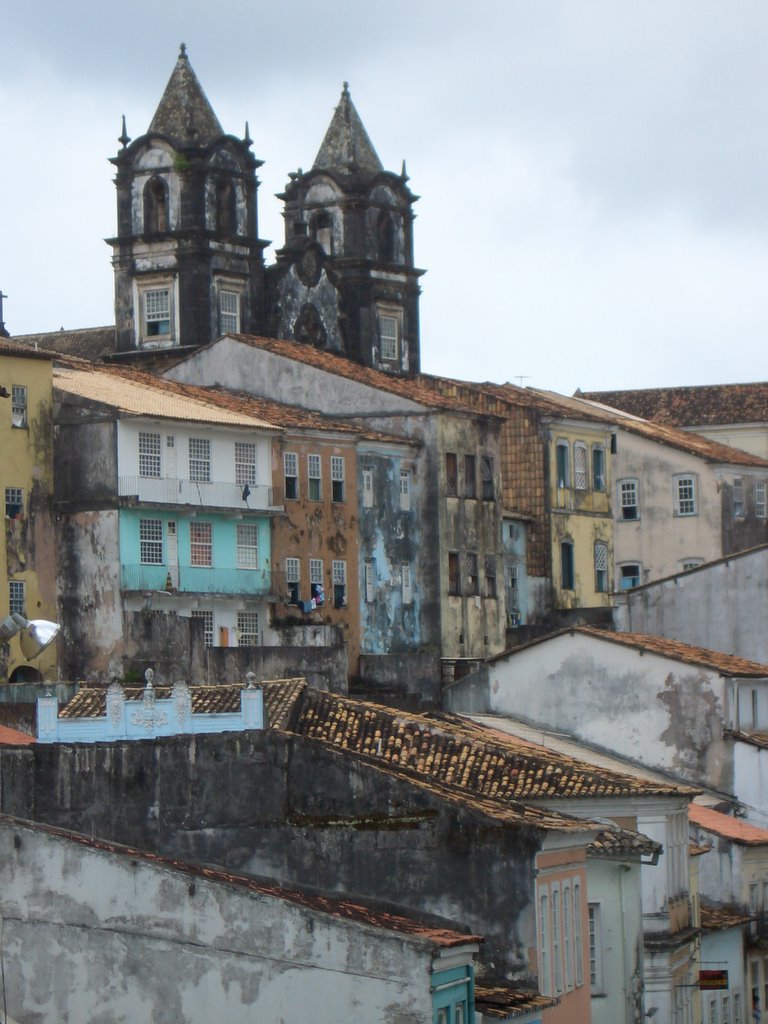
Here's a photographic taste of Salvador ...


But only the Pause button has been hit. Sunday evening I'm off to the Netherlands for another round of Roadmap presentations and meetings. It's exhausting and exhilirating at the same time. Ottowa, Portland, Amman, Tunis, Brazil, Amsterdam, Copenhagen . . . and then?
Washington, DC
Just returned from a wonderful and wired trip to Brazil. I was there at the invitation of Instituto CONIP for the launch of the portuguese version of the "Roadmap for Open ICT Ecosystems," the product of the Open ePolicy Group that I founded earlier this year.
It was a whirlwind tour -- 2 days in Brasilia for the CONIP 2005 conference, 2 days in Sao Paulo for a presentation at IBM Brasil and a series of press interviews, and then happily 3 days of pure holiday in Salvador. Thanks to Vagner Diniz of CONIP, Gabi Simionato Klein of TramaWeb, and Florencia Ferrar of e-Strategia Publica for helping make my time in Brazil easy, fun and productive.
Here's a photographic taste of Salvador ...

But only the Pause button has been hit. Sunday evening I'm off to the Netherlands for another round of Roadmap presentations and meetings. It's exhausting and exhilirating at the same time. Ottowa, Portland, Amman, Tunis, Brazil, Amsterdam, Copenhagen . . . and then?
Subscribe to:
Posts (Atom)


 Posts
Posts


