Open Tech Today - Top Stories

Wednesday, February 07, 2007

10 Things You Should Not Buy New


Interesting article on MSN Money by Liz Pulliam Weston listing 10 things you should generally never buy new (and it's more bad news for content creators) ...


1. Books
2. DVDs / CDs
3. Children's toys
4. Jewelry
5. Sports equipment
6. Timeshares (in real estate)
7. Cars
8. Software (and video games)
9. Office furniture
10. Hand Tools

Other things to add to the list ... clothes for kids under 2 years old? Skiis? Pets?

Anything you would add?

Monday, February 05, 2007

BBC Handcuffs Viewers to Microsoft

I love the BBC -- its news coverage, its TV shows, its website, its independence even in the face of pressure by its public paymasters. When it comes to technology, however, the BBC seems willing to trade that famous independence for a set of handcuffs.

Access to BBC on-demand TV services will be unavailable to consumers who do not have an up-to-date version of Microsoft Windows. It matters not what you think of Microsoft; forcing consumers to choose any single vendor, system or computer is unnecessary, wasteful and unfair.

Just ask the victims of Hurricane Katrina in 2005 who were unable to register online for disaster relief on the Federal Emergency Management Agency (FEMA) website. Online registration for disaster help required Internet Explorer initially.

The truth is: lock-in is a bad idea.

You can tell the BBC what you think about its plans on its website here.


Categories: consumers, lock-in, BBC, Microsoft

Friday, February 02, 2007

Global Warming? How about Global Coloring?

While politicans and scientists dither over the recent report on global warming issued yesterday by the Intergovernmental Panel on Climate Change, there was more colorful climate news from Siberia.

Oily, smelly, orange and yellow snow fell on several villages in western Siberia this week.

While they flew in a team of chemical experts to investigate, Russian officials also pronounced no serious health threats from the malodorous, tinted snow.

Despite their assurances, it might be best for Siberians to heed the famous words of advice given to kids in America ... "Don't eat the yellow snow."

Categories: GlobalWarming, Siberia

Monday, January 29, 2007

Leveraging Open Source (or Open Anything)

Declaring a commitment to open source and other open technologies is the easy part. Finding ways to actually leverage open ICT is hard, as governments are discovering.

This lesson is learned and re-learned every day, as two articles I saw today illustrated. First, a new survey in India indicated that one major challenge to growth of open source was customers convinced of its value remain unsure how to leverage open source in their organizations. This problem is directly linked to low skill levels and experience in open ICT, few incentives to explore open source options, how staff performance is measured, and a failure of leadership by senior managers.

The second story came from the Land of Kiwis where the New Zealand Open Source Society complained about the non-tender of a government software procurement. The NZ story highlights 2 major obstacle to successfully leveraging open source: (1) There is often no vendor representing an open source option, while proprietary vendors deploy armies of sales and marketing personnel; and (2) Too often tender documents (RFPs and RFIs) specify a specific vendor or product, thus totally eliminating the possiblity of any open source options.

In New Zealand, a government agency issued a tender (designed by an outside consultant) for a service provider to implement a Microsoft-based online registration system. Not an online registration system. A Microsoft-based system. Nothing against Microsoft, but governments should focus on the services they want to deliver, not forever locking themselves into one company or technology.

Wait-and-see approaches to procurement will not maximize choices, competition or value for money. Nor will they produce in open source options.

Unfortunately, old habits die hard. Service-oriented, technology-neutral procurement goes against everything that procurement officers and CIOs know or have learned. Only clear direction (and rewards) from an organization's leadership can change this.

Categories: opensource, procurement, government

Tuesday, January 16, 2007

Global Warming: Greenland Gains Island, India Loses One

At least in the short run, global warming is creating winners and losers. As average temperatures and sea levels climb, some places go green while others go under (water).

Greenland just got greener, adding an island off its coast that was once buried under glacial ice, now melted.

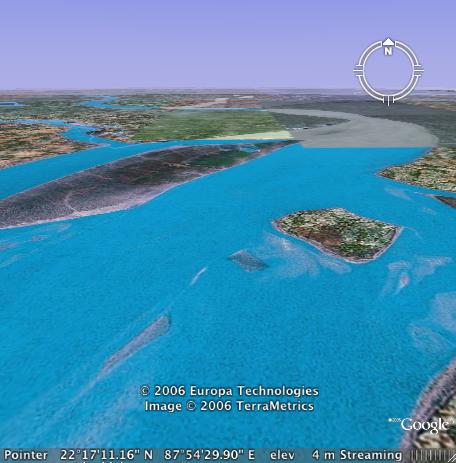
Neither climate computer models nor Google Earth can keep pace with global warming. In this photo, it still shows the island connected to Greenland's mainland by a glacial bridge. (It's the grey-white ice just above the words at bottom of photo)

Contrast Greenland's gain with India's loss. Just before the New Year, the island of Lohachara, once home to 10,000 souls, was submerged by the sea, as blogged about here. It was the first documented case of inhabited land lost to global warming.

The problem is... Greenland's newest island -- named Uunartoq Qeqertoq ("the warming island") in the Inuit language -- is uninhabited. Lohachara had a population of 10,000, and there is no re-location program available to its former residents.

Greenland's melting ice is the #1 contributor to rising oceans globally. It is losing 80 cubic miles of ice per year. That translates into a lot of water. More than Lohachara could withstand. More than a lot of other places will survive.

So global warming has its first namesake: Uunartoq Qeqertoq.

What will we call the next Lohachara?

Categories: GlobalWarming, Greenland, India

Sunday, January 07, 2007

Governments: Follow Consumers in ICT

Governments can learn a thing or two from consumers when it comes technology. And they should, especially when it comes to using and buying technology. After all, consumers -- the public -- are government's primary customers.

What ICT lessons should governments learn from consumers?

1. Services trump hardware. In the end, people care less about the hardware and more about the content and services that hardware delivers. Hardware becomes obsolete. Services and users endure. This is the main reason for governments and enterprises to focus on becoming service- and user-oriented, and leaving behind their (procurement) attention on hardware.

2. The physical is moving to digital. People like -- they want! -- new ways of getting information and services. They don't want to stand in lines. They don't want to wait on hold on the telephone. Enter "disruptive distribution channels." Internet, instant messages, email, Blackberries, podcasts, blogs, P2P, Bluetooth. They all represent new ways to access information and services -- from governments, companies AND, importantly, from each other.

3. New technologies become mainstream faster today. Consumers are adopting new technologies faster than ever now. And old technologies become obsolete faster than ever. Governments must be aware of this, or risk falling far behind their customers in the ICT they use and the delivery channels they want. Governments cannot afford to only think about upgrades; they need to think about the next generation of ICT (and distribution) to deliver public services and information.

To avoid becoming obsolete, governments need to take their technology cues from consumers.

Categories: consumers, ICT, government

Wednesday, January 03, 2007

Cities Will Be Innovation Leaders in 2007

Open source, open standards and open technologies will continue to make big news and big gains among governments and enterprises in 2007. However, I expect the real action -- the real leadership -- in open ICT will be by municipal governments. Cities are today's leading open innovators.

As 2006 ended, cities were driving technology innovation (and open ICT) in the public sector. Notable examples include:

* Netherlands: Amsterdam (and 8 other cities) issued a "Manifesto for Open Source in Government," committing themselves to bringing open ICT to city government. Amsterdam will commence an open source demonstration project in early 2007.

* France: the greater Paris region will become a center of excellence for open source software development. The effort will be a major public-private partnership aiming to provide a new foundation for innovation and growth.

* South Korea: A major city, Gwangju Metropolitan City, has been designated an Open Source City in order to promote regional software development and drive economic competitiveness. The city completed an Information Strategy Plan, identifying areas ripe for open source in their infrastructure. Execution begin in the education sector.

* Germany: A healthy competition exists among cities vying to be Germany's open source trendsetter. Current contenders include Munich, Nuremburg, Mannheim, and even tiny Schwäbisch Hall (population 36,000), the first to entirely replace Windows.

* Numerous cities big and small -- including Vienna, Bergen, Bristol, Birmingham, Barcelona, and even Kenosha, Wisconsin -- are adopting open technologies. The race is on, and there are new entrants every day.

The trend is clear: For leadership in open source and open ICT, look to your cities.


Categories: OpenSource, innovation, government

Friday, December 29, 2006

Ayles Ice, Lohachara & Our Bi-Polar Disorder

Although they are thousands of miles apart, the Ayles Ice Shelf and Lohachara Island have a lot in common. They are the newest victims of global warming.


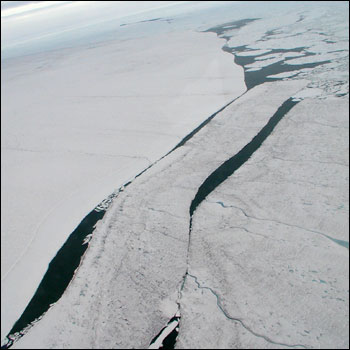
Canada now has a new floating island of ice, shown here breaking off from Ellesmere Island on August 13, 2005 ...


... while in India's Bay of Bengal an island has disappeared under the waves (It's now a smudge just below the island in photo), as blogged here recently.

Scientists reported today that the Ayles Ice Shelf, one of only six major ice shelves left in the Canadian Arctic, collapsed from the coast of Ellesmere Island into the sea. And it wasn't the first.


In 2002, the Arctic's largest ice shelf -- the Ward Hunt Ice Shelf -- broke up.


Is this news? It shouldn't be. In 2002, a paper published by the U.S. Geological Survey concluded by saying:
"The ice shelves [along the north coast of Ellesmere Island] were once much more extensive than they are today ... and it is reasonable to suppose that the disintegration of the Ellesmere Ice Shelf was a response to the pronounced warming during the last century ... It is difficult to ignore the connection between the state of the Ellesmere Island ice shelves, the state of the climate, and changes taking place elsewhere in the Arctic Basin. The ice shelves are bellwethers of climate change."
As a New Years resolution for 2007, we should wish all these ostrich-like politicians and skeptics to pull their heads out from the ice and see the bi-polar changes that global warming has already brought. Not to mention what's coming.

Categories: GlobalWarming, Canada, India

Wednesday, December 27, 2006

The Needle and the Damage Done (to Baseball)

Yet again, a federal authority is taking steps to restore integrity to America's national pastime forfeited by a shameful conspiracy between Major League Baseball and the Players Union.

Minutes ago, a federal court ordered that the urine samples of baseball players who tested positive for steroids in 2003 (the height of "juiced" baseball) can be used by federal investigators. This will undo a shameless, shady deal cut by MLB and the Players' Union to hide the evidence, protect the cheaters, and sell out the efforts of clean players.

That grey pall on Barry Bonds' name is one step closer to becoming a black mark, if his name is among those 100 samples that tested positive in 2003. Not that anybody seriously doubts his steroid use.

His personal trainer was guilty of steroid distribution, and sits in jail for refusing to answer questions about what Bonds knew. Hmm. Now why would he refuse to answer that question? Bonds' position is equally telling. He says that he never knowingly used steroids, though he admits using the infamous "cream" and "clear" distributed by Balco. What were the "cream" and "clear"? Steroids, as established in the Balco court case.

Anything to add Mr. Bonds?


Categories: baseball, steroids

Monday, December 25, 2006

No New Year for Lohachara

While most of us will celebrate the coming New Year with hopes for a joyful 2007, the people who lived on the tiny island of Lohachara in India will not. Their island, located where the great Ganges River meets the Bay of Bengal, is gone. It is the first inhabited island to fall victim to global warming. But surely not the last.

Lohachara had an address: Latitude 21.9 / Longitude 88.1058333.

It had a population: 10,000 inhabitants.

It had neighbors: Suparibhanga Island (uninhabited and also now submerged forever).


And now Lohachara has disappeared, swallowed by a rising sea. (It's the grey smudge just below the island in the center of the photo above).

I want to wish all those skeptical, "do nothing" politicians and "scientists" a special New Years wish ...

I wish for you to move to Lohachara's neighboring Ghoramara Island, or Sagar Island, or the Carteret Islands off Papua New Guinea, or Vanuatu ... stay awhile ... and then tell the world that global warming is not happening. I suggest, however, you bring some scuba gear and a boat.

Categories: GlobalWarming, India

Sunday, December 24, 2006

ODF v. OOXML -- Size Matters

Rob Weir has an excellent post comparing OpenDocument Format to ooXML, championed by Microsoft. The conclusion: Size matters.

The bottom line is that ooXML has a weight problem. Not only is it a bloated specification, but on average it also produces files that are bigger and slower than does its ODF rival when each is used by the same application.

This echoes the point made in my recent blog post about the practical differences between ODF and ooXML. In this Standards Smackdown!, differences in performance and complexity will likely impact decisions by developers about which standard to use.


Categories: OpenDocument, ODF, standards, ooXML

Saturday, December 23, 2006

Open Source Brings Neutrality and Manifestos

The debate about open source and open standards challenges governments to replace their rhetoric with tangible actions. Governments are gravitating toward the idea of issuing "technology neutral" policies as a starting point.

This raises two issues that most governments have yet to face: (1) What is technology neutrality? and (2) What must governments do to establish true ICT neutrality?

Neutrality (at least as rhetoric) appeals to everyone, governments and vendors alike. Few, however, have really considered what neutrality means and how to establish it.

A vigorous, open debate about technology neutrality is happening in at least one country -- Malaysia -- as evidenced by a recent opinion piece in its largest english-language newspaper the New Straits Times.

The second challenge -- creating genuine ICT neutrality -- is harder. Passive policymaking is not enough. As governments are learning, a "wait and see" approach produces endless waiting and little seeing.

As blogger here recently, the City of Amsterdam (and 8 other cities in the Netherlands) are waiting no longer. They signed a "Manifesto for Open Source in Government," committing themselves to exploring the use of open ICT. Amsterdam's City Council just announced that an initial test in the use of open standards and open source will begin in early 2007.

Do not be fooled by rhetoric, from governments or vendors. It matters less if someone uses the words "neutrality" or "manifesto." The only thing that counts is whether there are more choices in ICT procurement, whether vendor lock-in is eliminated, and who controls your data, documents and ICT decisions. Open is as open does.


Categories: OpenSource, ICTneutrality, Netherlands, Malaysia, government

Thursday, December 14, 2006

The U.N., Open Source and Repression

The United Nations helps governments use open source as a tool of repression, according to a group named the Inner City Press. Among their rambling and rumormongering, this group accuses the United Nations Development Programme (UNDP) of aiding the government of Uzbekistan in using open source as an instrument to support systematic repression.

I would offer a few general comments on this:

1. The UN has not shown much leadership in technology policymaking. UNDP itself has been incoherent and contradictory toward open source. While UNDP’s former chief, Mark Malloch Brown, urged Microsoft to work with the open source community, its IT Department organized marketing presentations to staff by big proprietary vendors. The gulf between the words of UNDP management and the actions of staff is often wide.

2. At least one group within the UN system (and ironically under UNDP) does an excellent job in promoting forward-thinking ICT policies: the Asia-Pacific Development Information Programme (APDIP). Unlike many UN agencies, it is focused, principled, competent and physically separate from UN headquarters.

3. Let’s be honest. UNDP’s mandate is to work in poor countries. And many poor countries have un-democratic governments. Partnerships with such governments are always difficult, often problematic and sometimes compromising.

Specifically, about UNDP’s project in Uzbekistan ...

UNDP’s technology efforts in Uzbekistan fall under a new project assisting the Uzbeki government in the formulation and implementation of ICT for development policy. According to UNDP, the project aims to promote an “[e]nabling environment for civil society to participate actively in the development process.” This is normal, meaningless UNDP fare.

The project—which runs from 2005-2009 with a budget of $535,000—included financing a report on free/open source software. It also supports typical UNDP project activities like study tours, seminars and other capacity-building efforts.

UNDP frequently works with governments of all persuasions to develop ICT policy frameworks. Nothing wrong with that. Technology is one aspect of a country’s development efforts. However, it is reasonable to ask whether UNDP should have certain policy parameters or conditions to avoid technologies of repression?

In other words, should UNDP attach strings to its ICT projects?

This is a serious question. Possible conditions might include making UNDP funding of ICT projects contingent upon partner governments not blocking access to news sites, or establishing privacy protections for users. And certainly UNDP should not provide or pay for software used enable censorship or limit user freedoms. It needs to openly and strongly condemn such practices.

Perhaps all UN agencies should consider setting common policies for ICT-in-development projects.

Three disclaimers:
o In the past I have worked for UNDP projects in various capacities.
o UNDP-APDIP participated in the Open ePolicy Group, which I founded.
o I know one person in UNDP’s office in Uzbekistan, though we have not discussed this post or these issues.

Categories: OpenSource, government, UnitedNations

Monday, December 11, 2006

Standards Smackdown!

Technology rarely sparks public debate, let alone political intrigue. But a “no holds barred” fight has begun in the technology world over document formats. That means nothing to most people. But it is turning the IT world into the UFC. This fight is not just among geeky programmers. Industry heavyweights and governments are getting ready to rumble.

Ecma's approval of the Office Open XML (ooXML) standard this week sets up a big showdown. A competing standard – the OpenDocument Format (ODF) – is already ISO-approved.

I noted in a recent CNET article that Ecma's approval of ooXML will increase confusion in the marketplace. Consumers and companies now face two different document standards. One is a proprietary-encumbered standard, the other an open standard. Both are endorsed by standards organizations and industry allies.

The average person, even the average corporate customer will be confused. And when it comes to technology, the uninformed are easily abused. Politicians, often among the most technologically challenged, are already being targeted. It’s about to get worse. A giant PR blitz is coming. Corporate commanders are fueling the FUD missiles.

The ultimate question is which document standard will become the standard?

One group will greatly affect the outcome – the actual consumers of standards: programmers and IT developers. They are the people who use the specifications of these 2 standards. These developers (and companies that employ them) must deal with reality. Software development is hard work, and complexity drives up costs. It is true for software. It will be true for document standards.

According to a new study, in Asia today 70% of computer programmers use open source software in their work. Why? It’s cheaper than proprietary software and allows total access to the source code. Applying ooXML, a standard bloated with proprietary functions, will be difficult and costly. These will be serious disincentives to IT developers not employed by Microsoft.

All those Asian software developers using open source – 50% of them will use XML next year. Will they be willing to endure to pain and costs of using ooXML instead of ODF, a simpler, more open standard?


Welcome to the standards smackdown. The fighters have entered the Octagon. It looks like a sumo champion will face a jui-jitsu master. It’s déjà vu all over again. Want to know the results the first time? It’s here.

Oh yeah – it's on now.

Categories: OpenDocument, ODF, standards, ooXML, Microsoft

Thursday, December 07, 2006

Dutch Cities Demand Open Source

Apparently, passivity is not working. A group of 8 cities in the Netherlands will wait no longer for the market to provide more technology choices. Fed up with poor interoperability and uni-vendor dependency, they are demanding open source software alternatives.

An article (in dutch) in the Dutch newspaper Trouw describes the effort by several large Dutch cities to access open source choices. Indeed, they have gone so far as to publish a manifest insisting on open source options from vendors who want to compete for municipal ICT contracts.

Is this the IT equivalent of Martin Luther nailing his 95 Theses to the door of the Wittenberg church?


Categories: open, source, procurement, Netherlands, government

Tuesday, December 05, 2006

Technology Neutral ≠ Open Source Inaction

Memo to governments: technology-neutral policies on procurement do not mean that governments should do nothing about open source. While governments like Malaysia are neutralizing formal preferences (or mandates) for open source, they should not become passive about procurement or competition within the ICT market.

Technology neutrality is not a natural state, for governments or anyone else. People have preferences, even if policies on paper do not. Removing a sentence from an Open Source Master Plan, as Malaysia has done, does not magically level the playing field in ICT procurement. Neither does an open source preference for that matter. Procurement trumps policy every time.

To establish a truly neutral and competitive procurement environment, governments need to focus on 2 things: (1) setting clear objectives; and (2) burning your old, standard RFPs.

For step 1, Malaysia has it right. Its OSS Framwork sets the right targets: increase software choices and interoperability, reduce total costs of ownership and vendor lock-in, and ensure security.

Step 2 -- changing how procurement is actually done -- is much harder. It requires both changing rules and how people act. Tweaking your procurement policies will not work because you cannot "tweak" people's behavior. More dramatic action is needed.

Three actions can help drive changes in procurement practices and behavior. First, issue new standard RFP provisions that show agencies what neutral language looks like. Second, establish new criteria for bid evaluation that takes proper account of how open source works in the market. Lastly, find a way to make agency interactions with vendors more transparent. Too often, procurement decisions are made behind closed doors before an RFP is even issued. That is not a formula for value for money.

Categories: open, source, procurement, Malaysia, government

Saturday, December 02, 2006

Government Procurement Adds to Open Source Problems

As governments embrace service-oriented and performance-based procurement, they are discovering one major problem: they are not very good at it. And this has serious implications for the adoption of open source solutions by the public sector.

Performance-based procurement of services presents new challenges, as U.S. federal agencies are learning. Services are not managed, measured or maintained in the same way as products. The focus is service needs, not products specifications. Procurement personnel trained in buying hardware and systems are spec-oriented, not outcome-oriented.

These difficulties are compounded with open source. Open source is just as disruptive of government procurement as it is for the IT industry. Worse, open source involves the procurment of both a software product (community-developed and often free) and support services (with performance-based contracts).

Common criteria for bid selection -- how well product meets specs, financial stability of the company, product costs, and alignment with current suppliers -- make no sense with open source. Getting the software and getting the support are often two different things.

While open source fits well with service-oriented procurement and its performance-based contracts, governments so far do not. More is required of IT staff with both open source and performance-based contracts before procurement begins. They need to understand the open source product/services and the outcomes they expect. They will need training to handle new demands with respect to estimating contract costs, conducting risk assessment, setting realistic baselines, performance benchmarks and financial incentives.

Metrics must become their new mantra.

Without a serious commitment to training, it is a lot to ask of any Acquisition Department.

Thursday, November 30, 2006

Lessons from the Open Source Frontier #2

Things with open source software are not always what they seem, or what is reported. Just ask the City Council of Birmingham (UK). Critics declared their open source effort a failure, but not so fast. Reports of the death of open source in Birmingham are greatly exaggerated.

According to its Head of IT, the City Council actually expects to realize cost savings over time, and contrary to press reports it plans to "significantly increase" its use of open-source.

Which brings us to a few additions to my original Lessons from the Open Source Frontier.

Lesson #3: Open source requires skills.

You can build them up or buy them. More likely, you should do both. But either way, a real migration is involved and requires experienced people--techs, installers and troubleshooters--to manage it. The level of skills on staff will impact the "team costs" (like project set-up, technical design, development, testing and training) that were so high in Birmingham. Investment to acquire those skills: real. Value of those skills for the next open source project: priceless.

Lesson #4: Objects in the mirror are less costly than they appear.

Government budgets are often short-term. The true TCO of technology projects is not. Costs for open source may differ greatly in the short term and long term. Special discounted license rates--such as offered by Microsoft to governments--affect the cost comparision in the short term. But start-up costs are not the only consideration. Vendor lock-in has its price. You never develop the technical and managerial skills needed to have more choices in the future. And the costs of your data/documents trapped in proprietary formats will always be there.

Even the iMpower Consulting report criticizing Birmingham notes:

"The extra resources involved in decision making and project management mean that the cost of this first-time open source implementation for BCC was significantly higher than for a comparable proprietary upgrade."

So, costs were higher the first time around. Is this a surprise? How much did the Windows license cost the first time around? The obvious implication is that management and training costs will be lower for future open source implementations.

Lesson #5: The price of lock-in is high, as is the price of freedom from it.


Identifying and eliminating technical "lock-in" is hard work, as Birmingham discovered. There are endless ways in which proprietary applications and configurations obstruct porting to any other technology. That is the price of lock-in, and it is permanently steep if you continue to live in a world of fewer choices. If you never move, you never feel the weight of the chains around you.

Lesson #6: Consider putting the cart before the horse.

Sequencing matters. Birmingham's rollout plans were ambitious, especially given the technical levels of its staff. A better business case may have been to begin by migrating applications before operating systems. Designing and implementing a Linux desktop system can be difficult. Yet, adoption of open source applications like Firefox and OpenOffice is often easy for users, as Birmingham learned. Either way, it should be budgeted and managed as a multi-year effort.

Tuesday, November 28, 2006

You Want Open ICT? Burn The Boats (or RFPs)

When it comes to technology policies, governments should heed the words of Hernan Cortez … “Burn the boats.” Or, more specifically, burn the RFPs.

Procurement is the real measure of a government’s approach to technology. How “open” a government is toward ICT is not measured by whether or not it buys open source software, but how it procures technology. It's not what you buy, but how you buy it that counts most.

As governments are discovering – most recently in Australia and UK-- tweaking existing procurement policies to encourage more bidding by open source companies will not create more choices, even when specific open source companies are pre-qualified.

Procurement band aids will not lead to increased competitive bidding, ICT choices and access to innovation. Your old procurement rules, evaluation criteria and standard RFPs will not work. They will not level the playing field. They will not break vendor lock-in.

Why? Because conventional government RFPs are structured for big, proprietary vendors. They evaluate bidding companies based on criteria inappropriate for open technologies.

For example, public agencies still focus more on purchasing products, while open source solutions are more about services and support. RFPs often under-value interoperability, and instead focus on system specs and large product suites. Criteria such as minimum annual revenues and established user base disadvantage small companies and tend to proliferate vendor lock-in.

And let’s be honest, too many RFPs are rigged, written in order to buy a specific solution from a specific company with whom the procurement officers have long-standing relationships. Their objective is not best value-for-money, competitive bidding or technology neutrality, but buying a specific system already pre-determined.

Sunday, November 26, 2006

Sunday in the Dark with George


I rarely comment on American politics here, restricting my blogging to issues of technology.


However, it is impossible to stand silent on the travesty that is President Bush's war in Iraq.

This entire Iraq fiasco has been a faith-based initiative from the beginning, perpetrated by a President wilfully ignorant of facts and other faiths, bolstered by officials with their own hidden (and deeply flawed) agendas. It is a classic example of presidential followership by a man with little understanding of the world.

To listen to President Bush speak about Iraq only confirms that he remains completely clueless about global politics, history and facts on the ground.

Bush in his own words ...

On the current situation: "Absolutely we're winning." (October 25, 2006).

On the Iraqi government: "We've all been impressed by the Iraqi leaders' commitment to maintain the unity of their country." (April 29, 2006)

On lesson of Vietnam for Iraq: "We'll succeed unless we quit." (November 17, 2006)

On the insurgency: "Those who want to stop the progress of freedom are becoming more and more marginalized." (January 4, 2006)

On Iraqi public opinion: "The Iraqi people are growing in optimism and hope." (June 25, 2005)

On Iraq's effect on the region: "The victory of freedom in Iraq is strengthening a new ally in the war on terror, and inspiring democratic reformers from Beirut to Tehran." (March 19, 2005)

On the current status: "I think we're making good progress." (January 26, 2005)

On the day Saddam was captured: "All Iraqis can now come together and reject violence and build a new Iraq." (December 14, 2003)

On WMD in Iraq: "We found the weapons of mass destruction. We found biological laboratories." (May 29, 2003)

And let us not forget...

"Major combat operations in Iraq have ended. In the battle of Iraq, the United States and our allies have prevailed." (May 1, 2003, as Bush stood below the infamous "Mission Accomplished" sign)

And now?

October 2006: deadliest month ever in Iraq. 3,709 Iraqi civilians killed.

November 22, 2006: Over 100 bodies found, victims of sectarian executions.

November 23, 2006 (one day later): deadliest day ever in Iraq. Over 200 killed in Baghdad alone.

Is it me, or is the trend line pretty clear here?

The Iraqi "unity" government is more oxymoron than government, and helpless to stem the sectarian conflict. A key member of that government, Shiite cleric Muqtada al-Sadr's bloc, has threatened to withdraw support for the Prime Minister should he even meet President Bush later this week. This same Prime Minister accuses factions in his own government of fuelling the conflict. This is the government central to success in Iraq?

There are no signs of democratic reformers awakening in the Middle East. Lebanon's government has collapsed, even before the most recent assassination of a prominent politician. Iran proceeds with its nuclear program. Yesterday in Bahrain, hard-line Islamist candidates swept to victory in parliamentary election. Hezbollah won elections in the Palestinian territories.

Worse, the insurgency, according to a classified report by this Administration, is now a self-financing operation, netting $70 - 200 million a year from illegal activities and ransom payments, aided by corrupt Iraqi officials.

Iraq produces a steady stream of bodies, and Bush ... an endless stream of platitudes.